
Can You Roof Over an Existing Roof in Eugene?
Putting new shingles over the old ones looks cheaper on paper. Here is when an overlay is actually allowed in Eugene, when the code forces a tear-off, and why the damp Willamette Valley makes it a bad bet more often than not.
It is one of the first cost-saving ideas a Eugene homeowner reaches for when the roof starts to go. Rather than pay a crew to strip everything down to the deck and haul it away, why not just lay a fresh layer of shingles straight over the tired one and skip the tear-off entirely. The pitch is appealing, and a contractor who wants the easy job will happily quote it that way. The number really is lower, at least on the day you sign.
The catch is that an overlay is only sometimes legal, only sometimes sensible, and in Eugene's wet, mossy climate it is the wrong call more often than it is the right one. Whether you can roof over an existing roof here comes down to three things: how many layers are already up there, what condition the deck underneath is in, and whether the manufacturer will still stand behind the new shingles. Get any one of those wrong and the cheaper option turns into the expensive one.
Table of Contents
What an overlay actually is
An overlay, sometimes called a recover or a layover, means installing a new roof covering on top of the old one without removing it first. The asphalt roofing trade draws the line plainly: a recover is installing an additional roof covering on an existing roof covering, while a full replacement means removing the old covering, repairing any damaged substrate, and installing new roofing on a clean deck.
The saving is real but narrow. You are paying for one thing less, the tear-off and disposal, which on a typical Eugene home is a day of labor plus dumpster and landfill fees. Everything else, the new shingles, the underlayment, the flashing, the permit, the crew time to install, stays the same. So an overlay does not halve the cost of a roof. It trims a slice off the bottom, and it does so by leaving the old roof in place where nobody can see what it is hiding.
The two-layer rule that decides it
The first question is not whether an overlay is a good idea, it is whether the code allows one at all. Oregon builds on the International Residential Code, and the code caps a home at two layers of roof covering. If your house already carries a single original layer, a second one is potentially allowed. If it already has two, the rule is absolute: everything comes off before anything new goes on.
There are more triggers than just the layer count. New roofing cannot go over an existing roof that is water soaked or has deteriorated to the point that it is no longer effective, and it cannot go over slate, clay, cement, or asbestos-cement tile. So even a single existing layer does not guarantee an overlay is on the table, because a soft, saturated deck is exactly the condition the code is written to keep new shingles off of.
How do you know how many layers are already up there? A roofer can lift a shingle at the eave and count the courses, or check the rake edge where the layers stack. On a house you have owned for a while, the permit history at the city can also tell you whether a previous overlay was ever recorded.
Eugene still requires a permit for an overlay
An overlay is not a way to skip the paperwork. Eugene Building & Permit Services requires a permit for any roofing project covering more than 25 percent of the roof, and a recover of the whole roof clears that threshold easily. Overlays are permitted where allowed, which means the permit is where the city confirms you are not stacking a third layer or covering a deck that should have been condemned.
That inspection is the homeowner's friend here, not an obstacle. The whole risk of an overlay is that it seals a problem out of sight, and the permit final is the one moment a trained inspector looks at the fastening, the flashing, and the layer count before the new roof becomes permanent. A contractor who wants to overlay without pulling a permit is a contractor to walk away from, for the same reasons that skipping any Eugene roofing permit costs more than getting one.
Why the Willamette Valley works against an overlay
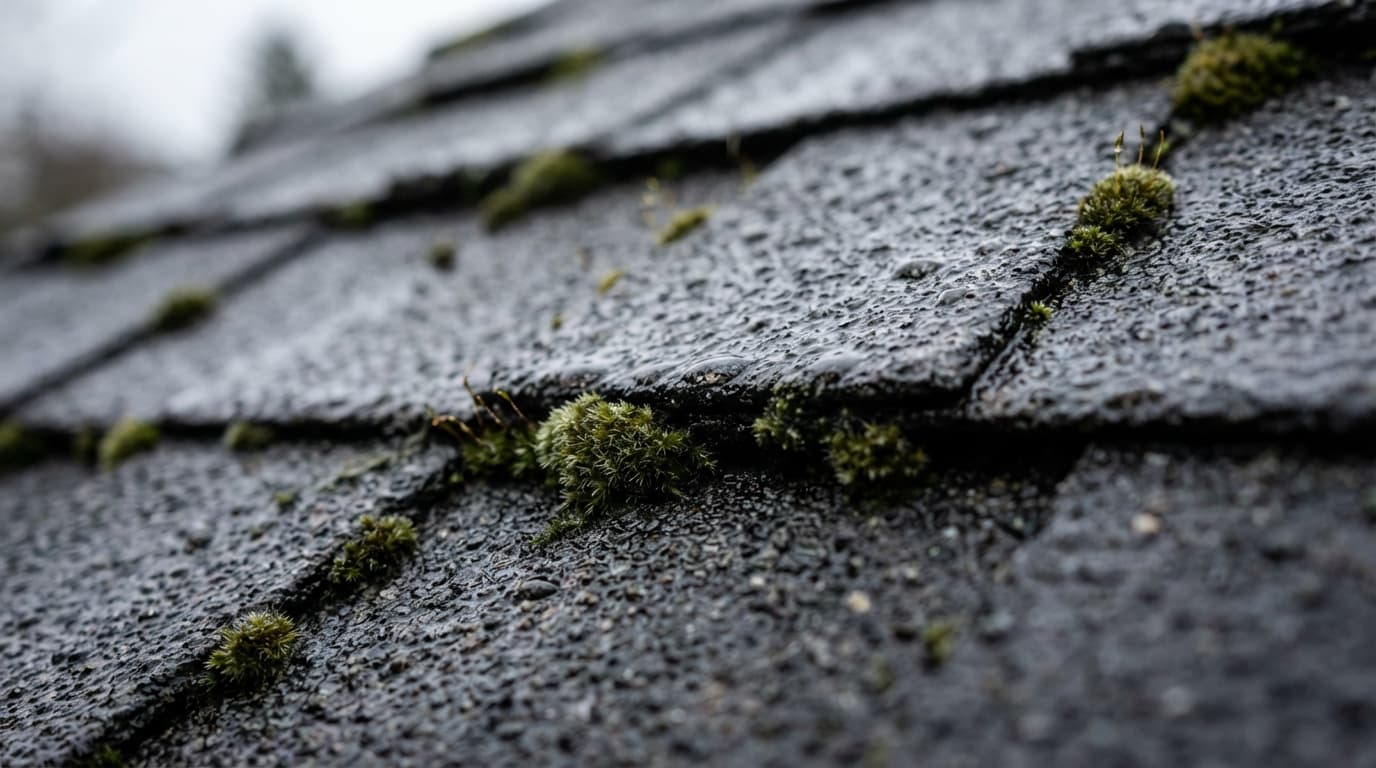
Even where the code permits it, Eugene's climate makes an overlay a worse bet than it would be in a dry state. The whole problem with a recover is that it traps the old roof underneath the new one, and the old roof up here is rarely just old. It is damp, and it has usually been feeding moss on the shaded slopes for years.
Lay new shingles over a layer that is already holding moisture and you seal that moisture against the deck instead of drying it out. Moss mats and cupped shingles also leave an uneven surface, and new shingles need to sit flat to seal and shed water properly. The trade guidance is direct on this: if the existing shingles are too uneven to be made flat, or the deck shows rot, warping, or gaps wider than a quarter inch, the old roof has to come off. In the valley, more roofs meet that description than a quick look from the driveway suggests.
There is a second, quieter cost. An overlay leaves the attic ventilation and the deck exactly as they were, so if the reason the first roof aged early was a damp, poorly ventilated attic, the new roof inherits the same shortened life. Correcting the airflow that keeps Eugene attics damp is the kind of fix a tear-off makes room for and an overlay papers over.
The warranty problem most homeowners miss
There is a cost to an overlay that never shows up on the quote: the manufacturer's warranty. Most major shingle makers, GAF and Owens Corning among them, will not honor their coverage when their product is installed over an existing layer rather than on a clean, prepared deck. Their engineering assumes a smooth substrate and a specific fastener bite, and neither is guaranteed when the nails have to pass through two layers of shingle.
So the overlay can leave you with a roof that has no meaningful material warranty behind it, which is a strange place to be after spending several thousand dollars. The impact-resistance rating can slip too, because a shingle rated for hail or debris on a solid deck is not tested for the cushioned, uneven bed an old layer provides. If a warranty matters to you at resale or for an insurance discount, the overlay quietly takes it away.
Before you accept an overlay quote, ask the contractor in writing whether the shingle manufacturer's warranty survives the install. If the answer is vague, assume it does not. A twenty-five or thirty-year warranty is a large part of what you are paying for, and an overlay is the fastest way to void it.
The added weight the deck has to carry
A second full layer of asphalt shingles is not weightless. The trade association's own guidance is to confirm that the structure beneath the deck has enough capacity to carry the weight of another layer before recovering, and on an older Eugene home that is not a formality. Framing that was fine for one roof can be marginal for two, and the extra dead load sits there permanently through every wet-season saturation and every rare snow event.
When the day finally comes to replace that doubled-up roof, the tear-off is heavier, slower, and more expensive than a single-layer strip would have been, because the crew is now hauling two roofs to the landfill instead of one. That is the hidden bill at the back end of an overlay, and it lands on whoever owns the house when the recovered roof reaches the end of its shorter life.
When an overlay is actually the right call
None of this makes an overlay always wrong. There is a genuine window where it is a sound, honest choice, and it is worth being clear about it.
- 1There is only one existing layer. The house has never been recovered before, so a second layer keeps you inside the two-layer code limit.
- 2The old shingles lie flat and intact. No cupping, no moss mats, no missing tabs, so the new layer has a smooth bed to seal against.
- 3The deck is sound and dry. No soft spots, no rot, no daylight through the sheathing, confirmed from inside the attic, not guessed from the driveway.
- 4The framing can carry the weight. On an older home, a contractor should be willing to confirm the structure handles a second layer before quoting one.
- 5You are not chasing a warranty. You accept that the material warranty likely goes away, and the shorter, warranty-free life is a trade you are making on purpose.
Meet all of those and an overlay can be the sensible, cheaper move on a roof that has years of deck life left. Miss any of them, especially on a damp valley home, and the tear-off is the one that saves money over the life of the roof. If you are weighing the two against each other, the economics of a full replacement versus a patch or an overlay are worth working through before you sign, and a straight tear-off and reroof is what most Eugene homes past their first roof actually need.
Frequently Asked Questions
Can you legally put a second roof over an existing one in Eugene?
Sometimes. Oregon's residential code caps a home at two layers of roof covering, so if there is only one existing layer, a second is potentially allowed. If there are already two layers, or the deck is water soaked or deteriorated, everything has to come off first. A full-roof overlay still needs a Eugene permit, and the inspection is where the layer count and deck condition get confirmed.
Is it cheaper to roof over the old shingles than to tear them off?
On the day you sign, yes, because you skip the tear-off labor, the dumpster, and the landfill fees. Over the life of the roof it is often not cheaper, because an overlay can void the shingle warranty, traps moisture against a damp valley deck, and makes the eventual tear-off heavier and more expensive. The saving is smaller than most homeowners expect.
Does an overlay void my shingle warranty?
Usually. Most major manufacturers, including GAF and Owens Corning, will not honor their material warranty when shingles are installed over an existing layer instead of a clean deck, and the impact-resistance rating can be affected too. Ask the contractor in writing whether the warranty survives the install before you agree to an overlay.
Why is roofing over the old roof a bad idea in Eugene specifically?
Because Eugene roofs are usually damp and often carry moss on the shaded slopes. An overlay seals that moisture against the deck instead of letting it dry, and moss mats and cupped shingles leave an uneven surface that stops the new layer sealing properly. It also leaves any attic ventilation problem in place, so the new roof inherits the same shortened life.
How do I find out how many layers my roof already has?
A roofer can lift a shingle at the eave or check the rake edge where the layers stack and count them. The city's permit history for your address can also show whether a previous overlay was recorded. Knowing the layer count is the first step, because two existing layers rules out an overlay entirely under the code.