
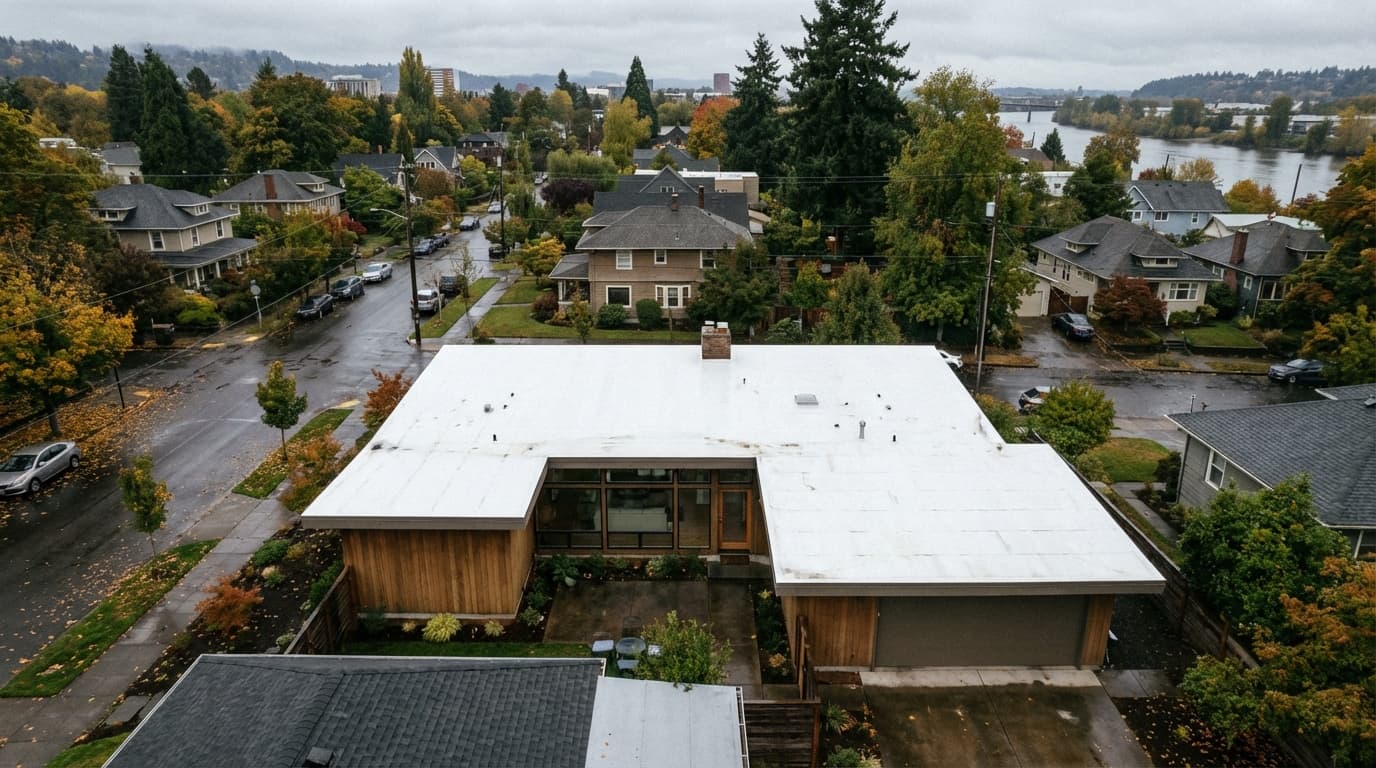
Flat Roofing in Oregon
Flat and low-slope roof sections appear on a meaningful share of Oregon homes, mid-century moderns, 1970s-1990s additions over carports and family rooms, garages, and contemporary new builds. Modern membrane systems (TPO, EPDM, modified bitumen) waterproof reliably when installed correctly with proper drainage. Most Oregon flat roofing projects cost $5,500 to $16,000 depending on area, system type, and drainage work required.
Flat Roofing in Oregon's Wet Climate
Flat roofs perform their best where drainage is engineered and rainfall is predictable. Eugene's 50-inch annual rainfall makes drainage design the single most important specification on any flat roof. The leading cause of premature flat roof failure in the Marine West Coast climate isn't membrane quality, it's water that ponds rather than draining. Membrane materials are designed to shed water within 48 hours of a rain event ending; standing water past that holds the membrane under continuous hydrostatic pressure and accelerates seam and penetration degradation. Oregon has a substantial stock of homes with 20-to-30-year-old flat roof sections built with first-generation EPDM or modified bitumen that are at or past end of life, repaired repeatedly, and reaching diminishing returns on continued patching. Replacement with a modern TPO system (heat-welded seams, properly engineered drainage slope) typically resets the performance clock for 20-30 years. The system decision matters: TPO with heat-welded seams is the current standard for most Oregon residential and light commercial work because the welded seam creates a monolithic surface. EPDM still wins where cold-temperature flexibility matters (smaller areas, foothill properties with hard freezes). Modified bitumen is appropriate where the roof deck will see foot traffic.
Our Flat Roofing Process
Drainage Assessment and Design
The most important step in any Oregon flat roofing project. The contractor evaluates current drainage, identifies any ponding areas, and designs a fix, additional drains, scupper placement, or tapered insulation that creates slope where the deck is essentially flat. No membrane quality can compensate for water that won't drain.
System Selection
TPO with heat-welded seams is the right baseline for most Oregon flat roofing because the welded seam eliminates the adhesive joint as a failure point. EPDM is preferred for cold-weather flexibility and small areas. Modified bitumen suits accessible deck applications. The system gets specified in writing with manufacturer, thickness, and warranty terms before any deposit changes hands.
Existing System Removal and Deck Inspection
Existing membrane and insulation comes off down to the structural deck. Oregon's moisture environment frequently leaves localised rot in flat roof decks that's invisible until the membrane is removed. Every board gets assessed and damaged sections replaced before new roofing goes on.
Insulation Installation
Rigid insulation board over the deck, providing thermal performance and (where tapered) contributing to drainage slope. Minimum R-20 is the Oregon standard for flat assemblies, under-insulated flat roofs in our wet climate are prone to condensation accumulation that degrades both insulation and deck.
Membrane Application
Membrane extends up parapets, around penetrations, and to drain and scupper connections. Heat-welded TPO seams are probe-tested immediately after welding to confirm bond integrity. Penetration boots and drain connections get extra membrane reinforcement, these are the highest-risk points in any flat roof.
Drainage Completion and Water Test
Drains, scuppers, and edge details finished. A water test (flood test) verifies drainage works within the design period before the crew leaves. Photo documentation of every seam, penetration, and drain connection goes to the homeowner with warranty paperwork.
Materials Comparison
TPO Membrane (Heat-Welded)
$400-$700/sqLifespan: 20-30 yearsPROS
- + Heat-welded seams create a monolithic waterproof surface, no adhesive failure mode
- + White reflective surface reduces summer cooling load
- + Industry-standard choice with wide Oregon contractor familiarity
- + Resistant to puncture and UV degradation
CONS
- - Quality varies significantly between manufacturers; specify tier-one product
- - White surface shows soiling in high-debris environments
- - Welding quality is critical, poor welds are the primary failure mode
EPDM Rubber Membrane
$350-$600/sqLifespan: 25-35 yearsPROS
- + 50-plus year field track record, the most proven flat roof membrane
- + Excellent cold-weather flexibility (relevant for foothill Oregon properties)
- + Easy to repair with compatible patch material
CONS
- - Black color absorbs heat
- - Adhesive seams are a potential failure point vs welded TPO
- - Less common than TPO in current Oregon market
Modified Bitumen
$300-$550/sqLifespan: 15-20 yearsPROS
- + Multi-layer construction provides redundancy
- + Excellent foot-traffic resistance for accessible deck applications
- + Self-adhering systems eliminate torch fire risk
CONS
- - Shortest lifespan of the three primary systems
- - Torch application (if used) requires careful management on residential decks
- - Less energy-efficient than white TPO
Frequently Asked Questions
Do flat roofs leak more than pitched roofs in Oregon?
Not when properly designed with positive drainage and installed with modern membrane materials. The reputation comes from older systems with adhesive seams that aged poorly, and from roofs where drainage was inadequate. Modern TPO with heat-welded seams and properly engineered drainage performs reliably in Oregon's rainfall.
How often should a Oregon flat roof be inspected?
Twice a year, once in spring after the wet season ends, once in fall before it begins. Pay particular attention to drains and scuppers: blocked drains are the most common cause of ponding in Oregon's heavy autumn leaf fall. Inspect after major storms for debris accumulation. Annual professional inspection is recommended for roofs more than 10 years old.
Can I walk on my Oregon flat roof?
Modified bitumen and EPDM handle foot traffic reasonably well. TPO is more susceptible to puncture from point loads. For any system, avoid walking in shoes with sharp edges or concentrated heel loads. If the roof is accessed regularly (HVAC maintenance, for example), install walk pads at the access point and along the travel path.
What causes flat roofs to fail prematurely in Oregon?
Four causes, in order of frequency: inadequate drainage design that allows chronic ponding; blocked drains and scuppers during Oregon's leaf-fall season; seam failures from improper welding or adhesive application; and deferred maintenance that lets small punctures admit water. All four are preventable with correct installation plus consistent twice-yearly inspection.
Repair or replace my Oregon flat roof?
If it's more than 15 years old and has had two-plus repair locations in the last three years, replacement typically wins. The membrane has lost flexibility across its entire surface; repairing one failure often reveals another within the same season. Full membrane replacement with modern TPO or EPDM costs $5,500-$16,000 but eliminates the repair cycle for 20-30 years.