
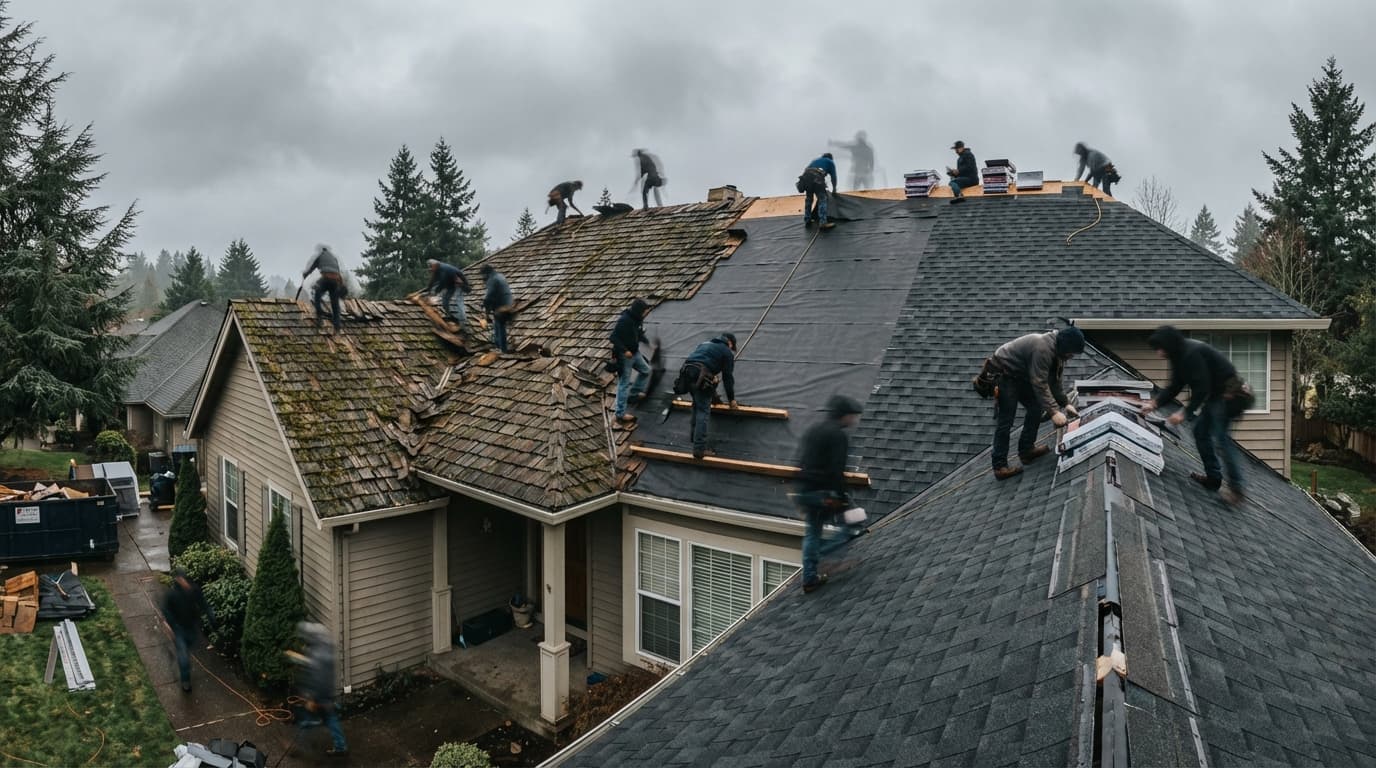
Roof Replacement in Oregon
Full roof replacement in Oregon runs $7,500 to $15,500 for most single-family homes, with the average around $10,800. The job strips the roof down to the structural deck, addresses any rot or delamination, then rebuilds with modern underlayment, ventilation, flashing, and shingles or panels. Eugene's Marine West Coast climate makes deck condition the variable that swings the final number more than anything else.
Why Oregon Homeowners Replace Rather Than Patch
Eugene's roofing market is driven by one structural fact: 50 inches of annual rainfall across more than 150 wet days a year, often falling on roofs under heavy Douglas fir canopy. Together those compress the real-world life of standard architectural asphalt by 5 to 8 years compared with the warranty number. By the time a Oregon roof is between 18 and 25 years old, the granule layer has thinned, moss has worked under shingle edges, and water has started reaching the deck. Patching at that stage delays the inevitable while letting the underlying deck rot. Replacement resets the entire system. Modern AR-granule architectural shingles (Malarkey Vista AR, GAF Timberline HDZ AR, CertainTeed Landmark Pro) are built for exactly the moss conditions Eugene throws at them. Standing seam metal goes further: the smooth surface gives moss nothing to colonize, and the 40-to-70 year life eliminates the next two replacement cycles entirely. Pulling the permit through Eugene Building & Permit Services takes 3 to 5 business days; rural Lane County jobs go through Land Management and add about a week. The crews in our network know the Eugene B&PS counter, the South Hills canopy decking patterns, the McKenzie corridor WUI Class A requirements, and the Oregon Residential Specialty Code 1:300 ventilation ratio that actually gets inspected at final.
Our Roof Replacement Process
Free Site Survey and Deck Read
A CCB-licensed crew walks the roof and the attic. The attic walk matters more than the exterior in Oregon: that's where you see condensation history, evidence of deck saturation, inadequate ridge-to-soffit ratio, and the underside of any prior leak path. The survey ends with a written assessment of likely deck condition (sound, partial sheet replacement, full overlay) so the quote that follows isn't a lowball that grows after tear-off.
Material Selection With Climate in Mind
Eugene-appropriate spec is not the national average. For most Oregon homes the right call is an AR-granule architectural shingle paired with a zinc ridge strip. For heavily canopied South Hills or Friendly Area locations, Malarkey Vista AR with 3M Scotchgard granules is the strongest performer. For eco-conscious buyers staying 20-plus years, standing seam metal pays back through avoided cycles. Your written spec names the manufacturer, product line, wind rating, fire class, and warranty in writing before any deposit changes hands.
Permit Through Eugene B&PS or Lane County
Roofing permits inside the Eugene urban growth boundary go through Eugene Building & Permit Services on Pearl Street; rural parcels permit through Lane County Land Management. Standard in-city processing is 3 to 5 business days; rural adds 3 to 5. Your contractor pulls the permit in their name. A contractor who suggests skipping it is transferring liability to you and will leave a gap in your home's permit record that buyers' inspectors flag at resale.
Tear-Off, Deck Repair, and Underlayment
Old shingles come off down to the deck. Every sheet gets inspected for rot, delamination, and inadequate fastening. Oregon's 1960s-1970s ranches commonly have a few CDX sheets that have aged poorly on north-facing slopes; pre-1925 homes often have skip-sheathed decking that needs a full plywood overlay. Per-sheet replacement runs $80-$130 and gets itemised, no surprises. Ice-and-water shield goes down at eaves, valleys, and around every penetration. Synthetic underlayment covers the field.
Shingle or Panel Installation
Starter strip, field shingles, valley flashing, step flashing at walls, counter flashing at chimneys, pipe boots, ridge cap. Installation follows the manufacturer's pattern (typically four nails per shingle, six in wind-exposed sites) because deviating from it voids the material warranty. Standing seam metal goes faster on simple rooflines but takes longer on complex hips and valleys; concealed fasteners and correct thermal expansion allowance are the difference between a 50-year roof and a 20-year roof.
Cleanup, Final Inspection, Walk-Through
Magnetic sweep of the driveway, lawn, and beds for fallen fasteners. All debris hauled and disposed of under Oregon DEQ requirements. The B&PS or Lane County inspector visits for the permit final, checking flashing, fastening pattern, and ventilation against the Oregon Residential Specialty Code. Your contractor walks the finished roof with you, hands over the permit card, manufacturer warranty documents, and the workmanship warranty in writing.
Materials Comparison
AR-Granule Architectural Asphalt
$375-$535/sqLifespan: 22-28 years (with maintenance)PROS
- + Best cost-to-performance ratio for the Oregon climate
- + Algae-resistant granules (Malarkey Scotchgard, GAF StainGuard) slow moss colonization
- + 30-50 year manufacturer warranties available; transferable adds resale value
- + Compatible with solar-ready conduit at install for $100-$300
- + Repairable if isolated damage occurs
CONS
- - Real-world life shortens by 5-8 years in heavily shaded Oregon neighborhoods if moss treatment is deferred
- - Granule loss accelerates on south-facing slopes
- - Less wind-resistant than standing seam metal
Standing Seam Metal (24-gauge)
$700-$1,200/sqLifespan: 40-70 yearsPROS
- + Smooth surface eliminates the moss problem that drives Oregon replacement frequency
- + Class A fire rating standard, useful for McKenzie corridor and Coast Range WUI properties
- + Compatible with clamp-mount solar panels (no roof penetrations)
- + Reflective coatings reduce summer cooling load 10-25%
- + Eliminates two future replacement cycles vs asphalt
CONS
- - Highest upfront cost
- - Requires installers with documented standing seam experience, not all roofers qualify
- - Oil-canning possible on wider panels in lower gauges
- - Custom panel fabrication can extend lead time by 2-4 weeks
Cedar Shake (#1 Blue Label, fire-treated)
$600-$900/sqLifespan: 25-35 years (with biennial maintenance)PROS
- + Authentic character for Craftsman, Arts and Crafts, and Northwest contemporary homes
- + Natural insulation roughly twice that of asphalt
- + Required by historic design review on contributing properties in some Oregon districts
CONS
- - Demands biennial cleaning, moss treatment, and fire retardant renewal ($800-$2,000 each cycle)
- - Skipping a maintenance cycle cuts effective life by 8-10 years
- - Untreated cedar isn't permitted on WUI parcels (McKenzie corridor, Coast Range west, Spencer Butte foothills)
Get Roof Replacement in Your City
Frequently Asked Questions
How long does a roof replacement take in Oregon?
Most single-family asphalt replacements in Oregon are done in 2 to 4 working days for a sound deck, single-story rectangle. Two-story or complex hip-and-valley rooflines run 4 to 6 days. Standing seam metal typically takes 4 to 7 days. Wet-season jobs (November to April) can stretch with weather pauses; if the forecast shows more than 0.25 inches of rain in 24 hours, work pauses to keep the deck dry between tear-off and dry-in.
Do I need a permit to reroof my Oregon house?
Yes. Eugene Building & Permit Services requires a permit for any reroof that exceeds 25% of the roof surface, which covers virtually every full replacement. Rural Lane County parcels permit through Lane County Land Management. Your CCB-licensed contractor handles the application. A contractor who suggests skipping the permit is the contractor to walk away from: unpermitted roofing leaves a gap in your home's permit record that buyers' inspectors flag, and can void homeowners insurance coverage on roof-related claims.
Can I stay in the house during the work?
Yes. The work is entirely external. Expect significant noise during tear-off (hammers, dropping debris into the dumpster) and during nailing. If you work from home or have a young child napping in a south-facing bedroom, plan around 7 AM to 4 PM crew hours. The interior of the house stays fully accessible throughout.
What's the best time of year to reroof in Oregon?
Late June through early October is the dry window when crews can dry in the same day they tear off, and shingles seal best at moderate temperatures. By mid-summer the Eugene crews are booked solid, so getting on a schedule by April for a summer install is the realistic timeline. Replacement is technically possible year-round, but wet-season jobs have weather pauses and longer durations. Emergency tarp work happens any time.
How much of a replacement might my insurance cover?
If your roof was damaged by a covered event (wind, hail, falling branch), homeowners insurance typically covers replacement minus your deductible. The big distinction is Replacement Cost Value vs Actual Cash Value: ACV deducts depreciation based on the existing roof's age, which can cut the payout substantially on an older roof. Check your declarations page before filing. Document storm damage with dated photos before any temporary repairs.
What's the cost difference between a 30-year and 50-year shingle in Oregon?
Typically $500 to $1,500 on a full replacement, depending on roof size. The 50-year products are heavier, hold granules longer, and carry stronger wind ratings. In Eugene's canopied neighborhoods that real-world performance gap matters, the cheaper shingle starts losing granules and lifting tabs sooner. For a 10-year homeowner the math is mixed; for a 20-year-plus homeowner, the premium shingle pays back through deferred replacement.