
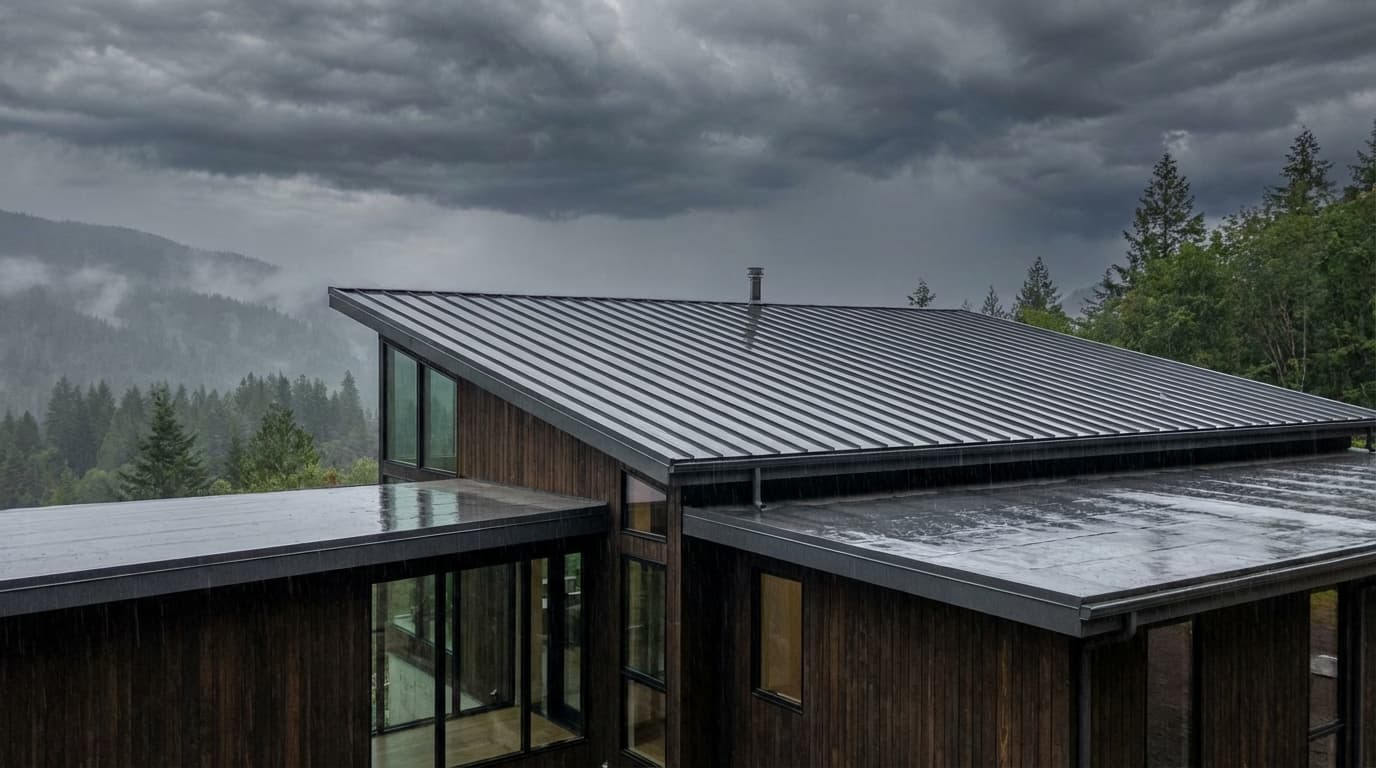
Metal Roofing in Oregon
Metal roofing in Oregon is the longest-life residential roofing option, 40 to 70 years properly installed, and it directly answers Eugene's moss problem because the smooth surface gives moss nothing to colonize. Standing seam is the right system for most Oregon homes; exposed fastener panels are appropriate for outbuildings. Most Oregon metal projects run $11,000 to $25,000 depending on panel type, gauge, and roof complexity.
Why Metal Roofing Fits Oregon
Two structural facts make metal roofing's lifecycle math work better in Eugene than almost anywhere else in the country. First, Eugene's moss problem. An architectural asphalt roof in the South Hills or Friendly Area canopy realistically lasts 18 to 22 years if moss treatment is deferred, 22 to 28 years with religious biennial treatment. A standing seam metal roof in the same location has no moss problem to manage, ever. The smooth panel surface holds no moisture between rain events, gives spores nothing to anchor in, and sheds water as fast as it hits. The biennial $300-$700 moss treatment cycle that adds $1,500-$4,000 to the lifetime cost of an asphalt roof simply doesn't exist on a metal one. Second, Eugene's eco-conscious buyer profile increasingly specifies solar. Standing seam metal is the only roofing substrate that lets solar panels mount with clamp systems that grip the seam directly, no roof penetrations, no leak risk, faster install, and the 40-to-70 year roof life exceeds the 25-year solar system life so you'll never need to remove panels to reroof. Combined with Oregon HB 4029's solar consumer protection framework, the case for spec'ing solar-ready metal during a replacement keeps strengthening. The upfront premium over asphalt ($5,000-$8,000 typical) breaks even in 17 to 22 years for most Oregon homes when you account for the avoided asphalt replacement cycle and the avoided moss treatment cost.
Our Metal Roofing Process
System Design and Panel Selection
Standing seam vs exposed fastener, panel profile, gauge, coating, color. For most Oregon residential applications, 24-gauge standing seam with a Kynar 500 coating is the right baseline. 26-gauge is acceptable for simpler rooflines. Concealed fasteners are the difference between a 50-year roof and a 25-year roof, and we recommend them for every residential application. Your contractor provides color chips and a written spec sheet including gauge, coating system, and warranty terms.
Structural Verification
Metal panels are lighter than tile but heavier than asphalt; older Oregon homes (pre-1950) occasionally need rafter assessment, particularly if you're transitioning from a lightweight existing roof or adding snow load capacity for east-side foothill properties. The contractor confirms structural adequacy before panels are ordered.
Precise Measurement and Panel Fabrication
Standing seam panels are fabricated to the exact dimensions of your roof. The contractor measures every plane and produces cut lists for the manufacturer. Lead time from order to delivery is typically 2 to 4 weeks for standard profiles, longer for custom colors or coastal-spec aluminum.
Deck Preparation and High-Temp Underlayment
Existing roofing comes off, deck is inspected and repaired. Metal roofing needs a clean, flat substrate, any deck deflection telegraphs through the panels. High-temperature synthetic underlayment goes across the entire deck before panels (standard felt isn't appropriate under metal because of the heat buildup at the panel surface in summer).
Panel Installation With Concealed Clips
Panels run from eave to ridge with concealed clips that allow the panel to expand and contract thermally without the fastener penetrating the weather surface. Correct thermal expansion accommodation is the most common failure point in metal roofing; experienced standing seam installers are genuinely different from general roofers in this respect. Each panel is seamed mechanically with a hand-crimper or roll-former depending on the system.
Trim, Flashing, Ridge, and Final Inspection
Custom-fabricated ridge cap, valley flashing, eave drip edge, rake trim, and penetration flashings complete the system, all in matching material and coating. The Eugene B&PS inspector visits for the permit final. Manufacturer warranty documentation (typically requiring a certified installer signature) goes to you with the workmanship warranty and permit records.
Materials Comparison
Standing Seam (24-gauge, Kynar)
$700-$1,200/sqLifespan: 40-70 yearsPROS
- + Concealed fasteners eliminate the primary metal-roofing maintenance point
- + Best weather resistance of any residential roofing system
- + Clamp-mount solar compatibility with zero roof penetrations
- + Class A fire rating standard, useful for WUI parcels
- + Smooth surface eliminates Eugene's moss-management overhead
CONS
- - Highest upfront cost of metal options
- - Needs experienced standing seam installer, not all CCB-licensed roofers qualify
- - Custom fabrication adds 2-4 weeks of lead time
- - Oil-canning possible on wider panels in lower gauges
Exposed Fastener (R-Panel / Pro-Rib)
$400-$700/sqLifespan: 25-40 yearsPROS
- + Cheaper than standing seam
- + Faster installation on simple rectangular rooflines
- + Wider pool of contractors qualified to install
- + Appropriate for detached garages and outbuildings
CONS
- - Exposed fasteners require periodic inspection and resealing every 10-15 years
- - Less refined appearance, not recommended for primary residence visible elevations
- - Not compatible with clamp-mount solar systems
Stone-Coated Steel Shingles
$500-$900/sqLifespan: 30-50 yearsPROS
- + Replicates the appearance of asphalt, slate, or shake at lighter weight
- + Excellent wind resistance (120 mph-plus typical)
- + Class A fire rating standard
CONS
- - More complex installation than panel systems
- - Fewer experienced installers in the Oregon market
- - Dent resistance varies significantly by gauge
Frequently Asked Questions
Is a metal roof loud in Oregon's rain?
No. Modern metal on a solid deck with synthetic underlayment and standard attic insulation is no louder than asphalt during rain. The noise association comes from metal on open-frame outbuildings (sheds, carports) with no insulation or air barrier. On a typical Oregon home with normal insulation, occupants typically can't distinguish rain on metal from rain on shingles.
Does a metal roof attract lightning?
No. Lightning is attracted to the tallest object in an area, not to metal surfaces. If a strike does occur, a metal roof is safer than wood or asphalt because it's non-combustible. Western Oregon's lightning frequency is low regardless.
Can I add solar panels to my Oregon metal roof?
Yes, and standing seam metal is the optimal substrate. Clamp-based mounting systems grip the seam directly with zero penetrations, no added leak risk, much simpler install than rail systems on shingle roofs. The 40-70 year metal roof life also exceeds the 25-year solar system life, so you won't need to remove panels for a reroof during the solar system's lifetime.
How does metal handle snow on Oregon foothill homes?
Metal sheds snow more effectively than asphalt thanks to its smooth surface, snow releases before it reaches the weights asphalt holds. That reduces structural load and eliminates the ice damming that plagues asphalt roofs when snow melts and refreezes at the eaves. Snow guards can be added near eaves to control the rate of release and protect landscaping or walkways below.
What's the break-even point vs. architectural asphalt in Oregon?
For most Oregon homes the break-even is 17 to 22 years when you account for the inflation-adjusted cost of two asphalt replacement cycles, the ongoing moss treatment cost on asphalt, and the cooling-load savings from metal's reflective coating. If you're staying 25-plus years, metal is cheaper over the ownership period. Selling within 10 years, asphalt is typically the better financial call.
How do I find a qualified metal roofing contractor in Oregon?
Ask how many standing seam projects the contractor has completed in the last two years, and request references from those installations specifically (not general roofing). Manufacturer certifications like McElroy Metal, MBCI, or product-line specific programs confirm factory training. Verify CCB status independently at oregon.gov/ccb and check that the license hasn't had complaints related to metal work.