
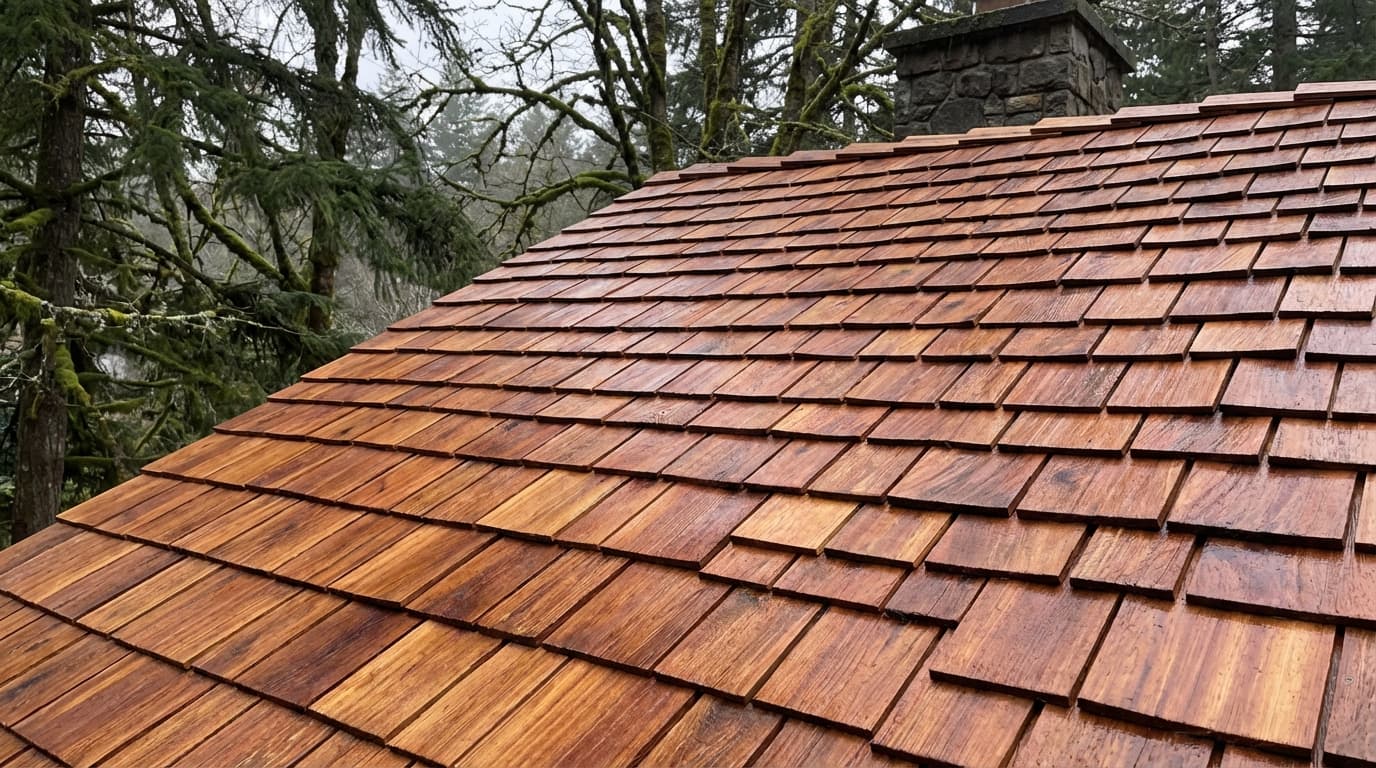
Cedar Shake Roofing in Oregon
Cedar shake is the heritage roofing material of the Pacific Northwest and the right call for the Craftsman, Arts and Crafts, and Northwest contemporary homes that define Oregon's architectural character. Hand-split western red cedar performs in Eugene's climate because the wood's natural oils resist moisture, insects, and decay. Most Oregon cedar shake projects run $14,000 to $26,000 fully installed, comparable to standing seam metal once natural insulation value and aesthetics are factored in.
Cedar Shake's Place in Oregon
Eugene has some of Oregon's finest concentrations of original cedar shake roofs, in the historic core, Whiteaker, College Hill, and the early-1900s craftsman stock around the university. Cedar is uniquely suited to the Marine West Coast climate: the wood's thujaplicins (natural oils) provide inherent resistance to moisture absorption, insect damage, and fungal decay without chemical treatment. The same oils give cedar its distinctive scent and the dimensional stability that lets hand-split shakes perform through Oregon's wet-dry cycling without warping. The insulation value (R-value roughly twice asphalt) contributes meaningful heating cost reduction through Eugene's cool months. For the right home, there's no substitute. The trade-off is honest: cedar demands maintenance (biennial cleaning, moss treatment, fire retardant renewal every 5-7 years) that asphalt and metal don't. Skipping a maintenance cycle compresses effective life from 30-plus years down to 15-20. WUI implications also matter, untreated cedar isn't permitted on McKenzie corridor, Coast Range, or Spencer Butte foothill parcels. Class A fire-treated cedar is available but adds cost and the treatment efficacy degrades over time. For a Oregon historic home in the right neighborhood with a homeowner committed to the maintenance cycle, cedar still wins. For everyone else, modern asphalt or metal is the more practical answer.
Our Cedar Shake Roofing Process
Grade Selection and Wood Specification
Western red cedar is graded #1 Blue Label (premium, clear wood, maximum thickness), #2 Red Label, and #3 Black Label. For a full Oregon replacement, #1 Blue Label is the right call, the grade difference affects lifespan significantly and the cost differential is modest relative to total project cost. Your contract names the grade explicitly.
Deck System and Ventilation Design
Cedar shake needs a ventilated deck assembly so moisture beneath shakes can escape rather than accumulating. Depending on roof pitch and local code interpretation, that's either spaced sheathing or a solid deck with cedar breather underlayment. Getting the deck system right is what makes cedar perform; cedar installed on an improperly ventilated deck can fail years earlier than the wood quality suggests.
Fire Treatment Verification
Eugene B&PS and Lane County both require Class B minimum on most parcels; WUI parcels (eastern foothills, McKenzie corridor, Coast Range west) require Class A. Factory-applied pressure treatments achieve Class B and Class A ratings and are documented with a label on each bundle. The treatment spec goes in the permit record.
Cedar Breather Underlayment
Cedar breather or equivalent goes down before shakes. Standard roofing felt isn't appropriate under cedar, it restricts the ventilation cedar needs to perform. The breather creates a drainage and ventilation plane below the shakes.
Individual Shake Installation
Each shake placed by hand with controlled exposure, correct offset from the course below, and stainless steel fastening (galvanized corrodes in Oregon's sustained moisture before the wood itself deteriorates). Hips, valleys, and ridges require hand-crafted detail work that separates experienced cedar installers from general roofers.
Ridge, Detail Work, and Maintenance Briefing
Hand-crafted ridge caps, custom valley flashings, all penetration details completed. Permit inspection verifies fire rating documentation and ventilation. The contractor hands over a written maintenance schedule, specific treatment products, application intervals, and inspection checklist for keeping the roof at its design life.
Materials Comparison
Hand-Split #1 Blue Label Shakes
$650-$950/sqLifespan: 30-40 years (with maintenance)PROS
- + Maximum dimensional character; defines the look of the architecture
- + Highest wood quality with minimal defects
- + Best insulation performance of common roofing materials
CONS
- - Highest cedar option
- - Demands biennial maintenance cycle
- - Not appropriate for low-slope sections
- - Fire treatment required in most Oregon WUI zones
Machine-Cut #2 Red Label Shingles
$500-$750/sqLifespan: 25-35 years (with maintenance)PROS
- + More uniform appearance, easier installation lowers labor cost
- + Retains cedar's natural moisture resistance and insulation value
- + Acceptable for most non-historic Oregon applications
CONS
- - Less dimensional character than hand-split
- - Same maintenance cycle as hand-split
- - Inappropriate for historic restoration where shake aesthetic is required
Factory Fire-Treated Cedar
$600-$900/sqLifespan: 30-45 years (with maintenance)PROS
- + Class A or Class B fire rating from factory treatment
- + Required for WUI parcels (McKenzie corridor, Coast Range west, Spencer Butte foothills)
- + Extended lifespan from treatment penetration
CONS
- - Treatment may alter natural color and weathering pattern
- - Higher cost than untreated
- - Treatment efficacy degrades over time, may require field reapplication
Get Cedar Shake Roofing in Your City
Frequently Asked Questions
Is cedar shake a fire hazard in Oregon?
Untreated cedar is a Class C combustible. Modern factory-applied pressure treatments achieve Class B (moderate fire resistance) and Class A (highest residential rating). Eugene B&PS requires Class B minimum on most parcels; WUI overlay parcels (eastern foothills, McKenzie corridor, Coast Range west) require Class A. Your contractor confirms the requirement for your specific address before specifying material.
How long does cedar shake actually last in Oregon?
With the maintenance cycle properly observed (cleaning, moss treatment, fire retardant renewal every 5-7 years), Oregon cedar shake lasts 30 to 40 years for premium #1 grade. The Marine West Coast climate is actually beneficial for cedar longevity vs arid climates, the wood retains its oils better when it doesn't dry out repeatedly. The main risk: deep shade plus neglected moss treatment can cut effective life to 15-20 years.
Can I install cedar shake over existing shingles?
No. Cedar shake requires a properly prepared, ventilated deck. Installing over existing roofing eliminates the air circulation cedar depends on. Eugene code also generally prohibits overlay in a full replacement. The old roofing has to come off, the deck inspected, and the ventilation system properly designed before cedar can go on.
What does cedar maintenance cost in Oregon?
A professional treatment cycle (cleaning, moss treatment, fire retardant application) runs $800-$2,000 every 5-7 years depending on roof size and access. Never pressure-wash cedar, it removes the natural oils along with the debris and significantly shortens the wood's life. Chemical cleaning and copper or zinc sulphate application is the correct approach.
Is cedar shake right for my Oregon neighborhood?
Cedar performs best in the climate zones Oregon sits in, moderate humidity keeps the wood supple. Check your specific situation: some historic districts effectively require cedar (or treated cedar) on contributing properties; some HOAs restrict it; WUI overlay parcels limit choice to fire-treated grades. Your contractor walks the local requirements for your address before specifying.