
How Do I Know If My Roof Needs Replacing?
The symptom checklist Eugene homeowners can run from the ground and the attic: granule loss, curling, moss mats, sagging, stains, and rising bills.
Most Eugene roofs do not fail all at once. They send signals for a year or two first, granules in the gutter, a shingle that lifts in a windstorm, a ceiling ring that dries and comes back. The hard part for a homeowner is knowing which of those signs mean a quick repair and which mean the whole roof is at the end of its life.
Here is the short answer: a roof needs replacing when the failure is systemic rather than spotty. One leaking flashing or a few wind-lifted tabs is a repair. Granule loss across whole slopes, widespread curling, moss mats that have lifted the shingles, a sagging deck, or several leaks at once point to replacement. This guide walks the symptoms you can check yourself, from the driveway and from the attic, so you know which conversation you are about to have.
Table of Contents
How old is the roof, and does the age match the symptoms?
Age is the first thing to check because it frames everything else. The same curled shingle means something different at year eight than at year twenty. In Eugene's wet, canopied climate, asphalt shingles run shorter than the printed warranty, and shaded north slopes age faster than the sunlit ones. Match what you are seeing against where the roof should be in its life.
| Material | Typical Eugene lifespan | Replacement zone |
|---|---|---|
| 3-tab asphalt | 14-18 years | Watch closely past 14 |
| Architectural asphalt | 20-26 years with care | Plan past 20 |
| Cedar shake | 25-35 years maintained | Inspect past 20 |
| Standing seam metal | 40-70 years | Rarely a concern |
If you do not know the roof's age, the install date is on public record. Residential roofing permits at Eugene Building and Permit Services or Lane County are date-stamped, so a quick records search settles the question. A roof past the replacement zone with two or more of the symptoms below is usually a replacement, not a patch.
Is there granule loss showing up in the gutters?
Asphalt shingles are coated with ceramic granules that shield the asphalt underneath from sun and rain. As shingles age, those granules loosen and wash down into the gutters. A scoop of coarse, sand-like grit in the gutters or under a downspout on a roof past ten years old is a sign the shingles are wearing out from the top down.
A little granule loss on a brand-new roof is normal manufacturing excess and means nothing. What matters is bare patches where the black asphalt mat shows through, especially on the south-facing and west-facing Eugene slopes that take the most direct sun. Once the mat is exposed, that section has no protection left and the clock runs fast.
Check the gutters in spring after the wet season has flushed the loose granules down. A flashlight in the downspout outlet tells you more than squinting at the roof from the ground.
Are the shingles curling, cupping, or lifting?
Shingles distort in a few telltale ways as they fail. Cupping is when the edges turn up and the shingle looks like a shallow saucer. Clawing is the opposite, the center buckles up while the edges stay down. Both come from age, trapped attic moisture, or poor ventilation, and both mean the shingle has lost its flexibility.
Lifted tabs tell you where to look. A few lifted along the eaves usually means wind got under them, which is a repair. Tabs lifting across the broad field of the roof means the adhesive strip has aged out everywhere at once, which is a whole-roof problem. If you can see curling or cupping from the ground on more than one slope, the roof is past the point where spot repairs hold.
Has moss damaged the shingles, or is it just sitting on top?
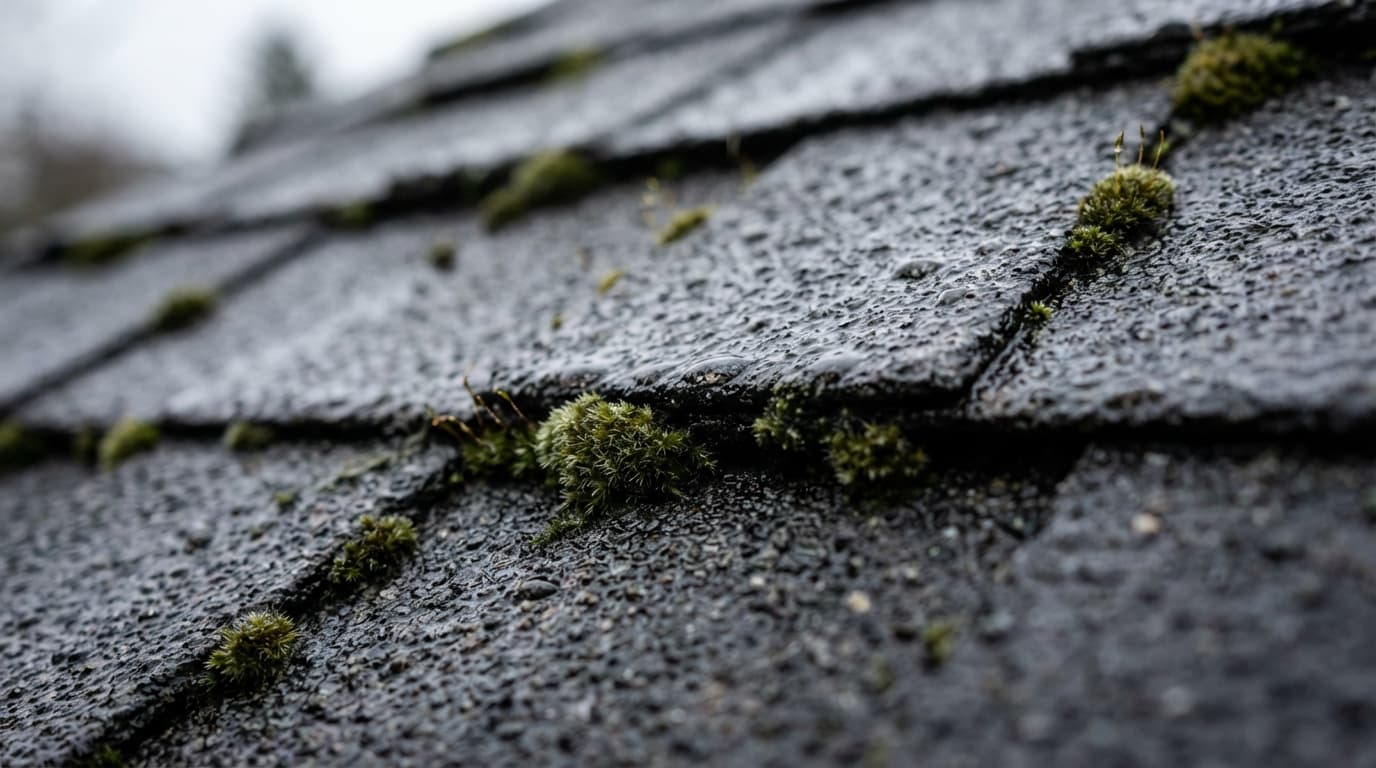
Moss is the Eugene-specific signal, and it cuts both ways. A green film on a shaded slope is treatable and does not mean replacement. The problem is thick, established moss mats: the roots work under the shingle edges, lift the tabs, and let water in, and over a few wet seasons that delaminates the shingle from below. Dead, gray moss that has sat for a couple of years often means the material underneath is already gone.
The test is simple: a roofer lifts a patch of moss and looks at the shingle beneath. If it is sound, you treat the moss and move on. If it crumbles or the granules are gone, the moss has been winning for years and that is replacement territory. In the heavily canopied neighborhoods, South Hills, Friendly, and College Hill, north-facing slopes are where this shows first.
Treating moss before the wet season is the cheapest roof protection there is. OSU Extension covers how to control roof moss without damaging the shingles in the process.
Is the ridge or deck sagging?
Step across the street and look at the ridge line straight on. New construction is dead straight; a slight dip over a long span is normal on an older Eugene home; a clear wave or a pronounced sag in the middle is a structural warning that needs a professional out promptly. In this climate, ridge sag almost always traces back to prolonged moisture rotting the roof deck underneath.
Confirm it from the attic on a dry day. Look at the underside of the decking for dark stains, soft or spongy spots, or visible rot, and check whether daylight shows through anywhere. A sagging deck is not a shingle problem, it is a structural one, and it almost always means a full tear-off so the decking can be replaced before new roofing goes down.
Never walk a roof you suspect has a soft deck. Spongy decking can give way underfoot, and a sagging ridge is exactly the case to inspect from the attic and the ground, not from on top.
Are there interior stains, or has the heating bill crept up?
Interior symptoms tell you the roof is already letting water or heat through. A single ceiling ring or one patch of peeling paint near a roofline is usually a flashing repair. Stains in several different rooms, or a leak that keeps coming back after it was supposedly fixed, point to systemic failure rather than one bad spot. In the attic, pinpoints of daylight through the deck mean open holes above.
A roof can also fail your wallet before it leaks. If heating costs have climbed over a few winters with no change to the furnace or insulation, a deteriorated roof and water-flattened attic insulation may be bleeding heat. Sealing air leaks and adding attic insulation can save up to 10% on annual energy bills, so an energy audit is a cheap way to confirm whether the roof is the weak point.
| What you see | Likely a repair | Likely a replacement |
|---|---|---|
| Ceiling stain | One spot, one room | Several rooms or recurring |
| Lifted shingles | A few at the eaves | Across the whole field |
| Moss | Green film, sound shingles | Thick mats, crumbling shingles |
| Deck | Firm, dry decking | Soft, sagging, daylight showing |
When the signs add up to replacement
No single symptom forces a new roof on its own. The judgment call is about how many show up together and how widespread each one is. A roof past its Eugene lifespan with granule loss on multiple slopes, field-wide curling, established moss mats, and stains in more than one room is telling you it is done, and patching it just delays the cost while the decking takes on water.
One more local tell: tract homes built in the same Eugene development tend to reach end of roof life within a couple of years of each other. If several houses on your block have been reroofed lately and yours is the same age, that is a reasonable prompt to get an inspection. When two or more of the signs above line up on an older roof, the question has usually shifted from whether to replace to when.
Frequently Asked Questions
What is the clearest sign a roof needs replacing?
Widespread, not spotty, failure. Granule loss across whole slopes, curling shingles over the broad field of the roof, or several leaks at once all point to systemic end of life. A single leak or a few wind-lifted tabs is almost always a repair instead.
How long do roofs last in Eugene?
In Eugene's wet, shaded climate, 3-tab asphalt typically lasts 14 to 18 years, architectural asphalt 20 to 26 with maintenance, and cedar shake 25 to 35. Standing seam metal runs 40 to 70 years. Shaded north slopes age faster than sunlit ones.
Does moss on the roof mean I need a new roof?
Not by itself. A green film on a shaded slope is treatable. The concern is thick, established moss mats whose roots have lifted and delaminated the shingles. A roofer can lift a test patch to tell whether the material underneath is still sound or already gone.
Can rising energy bills mean my roof is failing?
They can. A deteriorated roof and water-flattened attic insulation let heat escape before any leak shows. If heating costs have crept up over a few winters with no other change, an energy audit can confirm whether the roof and attic are the weak point.
How can I check my roof without climbing on it?
Most signs are visible from the ground and the attic. Look for granules in the gutters, curling or lifted shingles, moss mats, and a sagging ridge from the street, then check the attic for stains, soft decking, and daylight through the roof deck.
Should I repair or replace my roof?
Repair when the problem is contained, one flashing, a few tabs, a single leak. Replace when the failure is systemic or the roof is past its Eugene lifespan with several symptoms at once. A test patch and the attic check usually make the call clear.