
Should I repair my roof or just replace it?
The repair vs replace decision for Eugene roofs: the 30 percent rule, when patching is the right call, when replacement wins, and the cost math behind it.
Almost every Eugene homeowner who gets a leak fixed asks the same question while the roofer is still on the ladder: was that a patch I will be paying for again next winter, or should I just replace the whole thing? It is the right question, because the wrong answer is expensive in both directions. Replace too early and you throw away years of life you already paid for. Patch too long and you spend a quarter of a new roof keeping an old one limping toward the same end.
The direct answer: repair when the damage is bounded, recent, and sitting on a roof with real life left, and replace when the failures are spreading, the roof is past about 20 years, or the deck underneath has started taking water. This guide walks the 30 percent rule, the cases that clearly favor each path, and the running cost math that tells you when one tips into the other in Eugene's wet, canopied climate.
Table of Contents
The 30 percent rule, and where it breaks down in Eugene
The industry rule of thumb is the 30 percent threshold. If the damage affects less than about 30 percent of the total roof surface and the surrounding shingles are sound with several years of life left, a targeted repair is the better financial call. Once damage crosses 30 percent, or the surrounding roof is showing systemic wear rather than one bad spot, replacement starts returning better value than patching because you are no longer fixing a roof, you are propping one up.
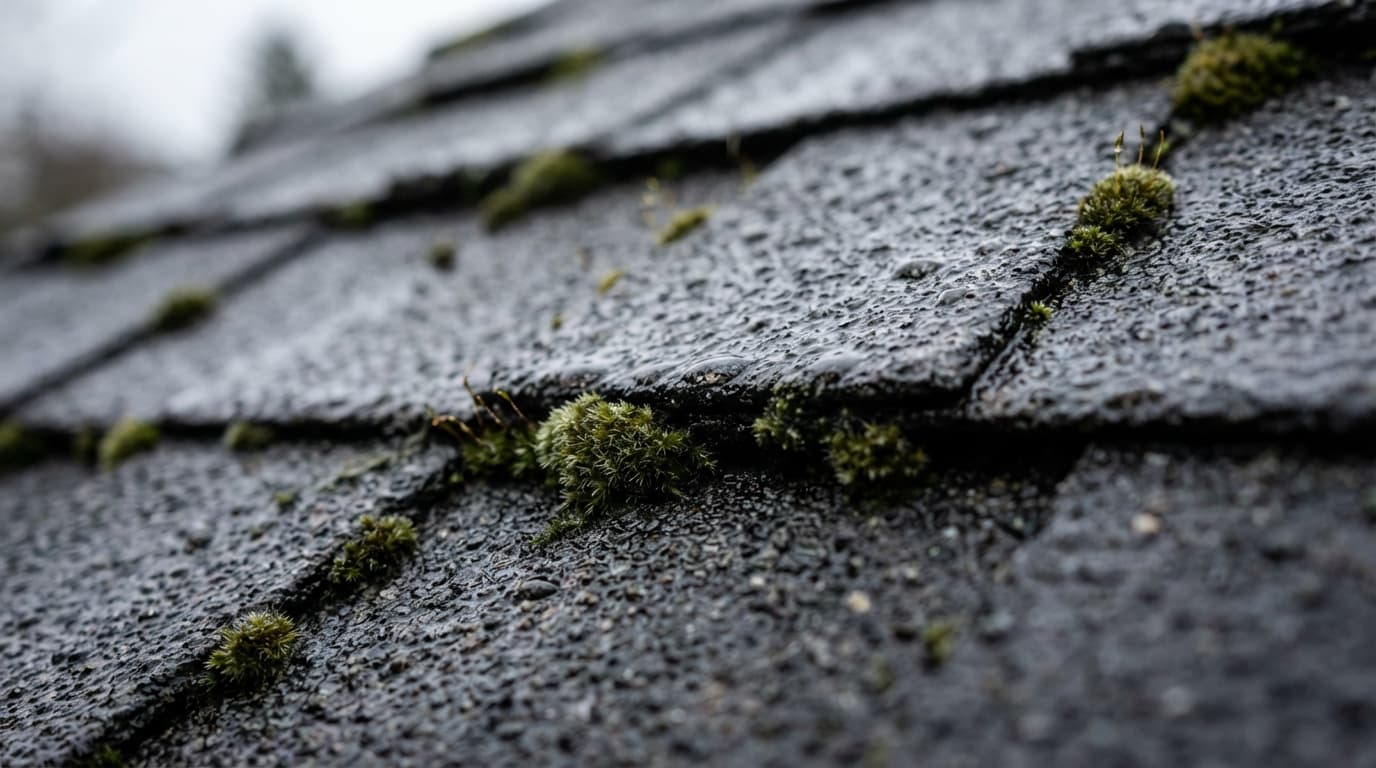
The rule is a starting point, not a verdict, and in Eugene it tends to understate the damage. Moss is the reason. A roof that looks maybe 20 percent damaged from the driveway can read far worse once a roofer pulls the moss mats off the north-facing slopes and finds the tabs lifted and the mat softened underneath. The shaded canopy that keeps so much of the city damp also hides how far the deterioration has actually spread, so the honest percentage is usually higher than the ground-level guess.
Treat the 30 percent rule as the moment to get a real inspection, not as a number you can eyeball from the ground. In canopied Eugene neighborhoods the surface under the moss is what decides repair versus replace, and you cannot see it until someone clears the growth and looks.
When a repair is the right call
Repair wins whenever the damage is contained and the rest of the roof still has years left to give. Spending on a full replacement in these cases throws away life you already bought. Three situations clearly favor a repair:
- 1A discrete recent event on an otherwise sound roof. A wind-lifted shingle, a fallen branch, or a single damaged section on a 5 to 15 year old roof. The damage is bounded and everything around it is fine, so you fix the spot and leave the good roof alone.
- 2A known single failure point. Deteriorated flashing at a chimney or skylight, valley flashing nearing end of life, or a cracked plumbing vent boot on a roof in the 8 to 15 year window. A targeted repair restores the failed part without touching the sound field.
- 3A bounded insurance claim. When a covered event such as a windstorm caused contained damage and the carrier is paying to repair it, repair is almost always the right move.
The common thread is that the roof itself is not the problem. One component failed, or one event did localized harm, and the underlying shingles and deck are still healthy. In that case repair is not a stopgap, it is the correct and complete fix.
When replacement is the smarter money
Replacement wins when the math of continued patching gets worse than starting fresh, which happens once the failures stop being isolated. Watch for these signals, and treat any two of them together as a strong push toward replacement:
- Roof age of 20 years or more with visible widespread wear, not just one bad area.
- Multiple leaks in different locations across a single wet season, which points to the whole system aging out rather than one failed part.
- Granule loss across several slopes at once, not confined to one face of the roof.
- Any sign of deck trouble underneath: sagging between rafters, soft or spongy decking, or daylight and moisture staining visible from the attic.
At year 22 on an asphalt roof in canopied Eugene, even a successful repair usually just pushes the inevitable out a season or two. Worse, during that interval the deck keeps taking moisture, and a soaked, softened deck adds real cost to the eventual replacement because those sheets have to be torn off and replaced at roughly 80 to 130 dollars each. Patching a roof that is already failing can quietly raise the price of the replacement you were trying to avoid.
Soft or spongy decking is the line in the sand. Once water has gotten into the deck, you are no longer choosing between repair and replacement, you are choosing between replacement now and a larger replacement later. The longer the deck sits wet under Eugene's rain, the more sheets you end up paying to swap out.
The cost math: when patching stops paying
A single Eugene repair is cheap relative to a new roof, which is exactly why patching feels like the safe choice for so long. The trap is that the repairs stack. The decision is not repair versus replace on any one visit, it is the running total of repairs against the cost of being done.
| Repair | Typical Eugene cost | When it makes sense |
|---|---|---|
| Plumbing vent boot | $150-$400 | Single split boot, sound roof around it |
| Flashing repair or rebuild | $350-$1,400 | One failed transition, chimney or skylight at the top end |
| Shingle section replacement | $250-$900 | Bounded wind or impact damage |
| Valley flashing repair | $400-$1,200 | One worn valley on an otherwise sound roof |
Across a 22 year roof life, two or three repairs in those ranges is normal maintenance and nothing to worry about. The problem is the pattern that shows up late in a roof's life: 400 dollars in year 16, 700 in year 18, 900 in year 20, 1,200 in year 21. That is 3,200 dollars over five years, roughly a quarter of a typical Eugene replacement, spent on a roof that still needs replacing at year 22 or 23 anyway. Once you can see that staircase forming, the next repair is usually the wrong purchase.
A simple test: if the cost of the next repair plus the repairs you have already made in the last few years is approaching a third of what a new roof would cost, and the roof is past 18 years, you are almost certainly better off replacing. Run the numbers against the cost ranges in the parent cost guide before you authorize another patch.
The case for replacing a little early
Sometimes the better decision is to replace a roof that could technically be patched for another year or two, because a new roof does more than stop leaks. A new roof scored a perfect satisfaction rating in the National Association of Realtors Remodeling Impact Report and is among the projects buyers most want to see, which matters in Eugene's tight inventory where an aging roof is a line buyers routinely use to negotiate an offer down. The honest caveat is that roofing does not fully recover its cost at resale, so this argument carries weight mainly when you are selling soon or the roof is genuinely near end of life.
A reroof is also the cheapest moment you will ever have to fix what is under the deck. With the roof open, addressing attic ventilation and insulation is straightforward, and the EPA's ENERGY STAR program estimates homeowners save around 15 percent on heating and cooling costs by sealing and adding attic insulation, savings that are easy to capture during a replacement and awkward to retrofit afterward. If your roof is already at the edge, doing it as a planned project beats doing it as an emergency after the next leak.
When you do decide to replace, the next questions are material choice and what a fair Eugene quote looks like line by line. Our roof replacement service page covers the spec and the process, and the parent cost guide breaks down the real numbers for the moss climate.
Get both options in writing before you decide
The right answer is usually obvious once both paths are documented honestly, so the real risk is the contractor, not the roof. A trustworthy Eugene roofer will show you the deck condition, the shingle condition, and the specific failure points, then give you the repair option and the replacement option with the reasoning for each, in writing.
- Be skeptical of anyone whose first move is 'you need a full replacement' without showing you the deck and the actual failure points.
- Be equally skeptical of anyone promising endless cheap repairs that never address an obviously aging roof.
- Ask for the per-sheet deck repair rate up front, so a repair quote cannot balloon after the work starts.
- Confirm the contractor is CCB licensed before anyone gets on the roof, and that any work over 2,000 dollars is in a written contract as Oregon law requires.
Avoid the storm-chaser who knocks after a windstorm offering a same-day cash fix or a deductible waiver. Deductible waivers are illegal in Oregon, and these are the most common source of bad Eugene repairs that send you straight back into the repair versus replace question a year later.
Frequently Asked Questions
When should you repair a roof instead of replacing it?
Repair when the damage is bounded and recent and the rest of the roof is sound with years of life left, such as a wind-lifted shingle, a single fallen branch, or one failed flashing on a roof under 15 years old. If the failures are spreading, the roof is past 20 years, or the deck is wet, replacement is the better call.
What is the 30 percent rule for roof replacement?
It is the rule of thumb that if damage affects less than about 30 percent of the roof and the surrounding shingles are sound, repair is the better value, while damage above 30 percent favors replacement. In Eugene the real figure is often higher than it looks, because moss hides how far the deterioration has actually spread until a roofer clears it.
Is it cheaper to repair or replace a roof?
A single repair is far cheaper than a replacement, usually a few hundred to about 1,400 dollars in Eugene versus several thousand for a new roof. But repairs stack, and once you are spending close to a third of a replacement on patches for a roof past 18 years, replacing is the cheaper outcome over time because patching an aging roof only delays the same expense.
Does a leaking roof always need to be replaced?
No. Most leaks in Eugene start at a single flashing, vent boot, or valley and can be repaired without touching the rest of the roof, as long as the surrounding shingles and the deck are still sound. Replacement only enters the picture when the leak is a symptom of a roof that is widely worn or has water in the decking.
How do I know if my roof deck is damaged?
From the attic, look for sagging between rafters, soft or spongy decking, daylight, or dark moisture staining on the underside of the deck. Soft decking means water has already gotten in, which shifts the decision firmly toward replacement, since each rotted sheet adds to the cost the longer it stays wet.
Should I replace my roof before selling my house in Eugene?
Often yes if the roof is near end of life. A new roof is among the projects buyers most want to see and removes a common point buyers use to negotiate down, though roofing does not fully recover its cost at resale. If the roof has years of honest life left, disclosing its age and condition usually beats replacing it just for the sale.