
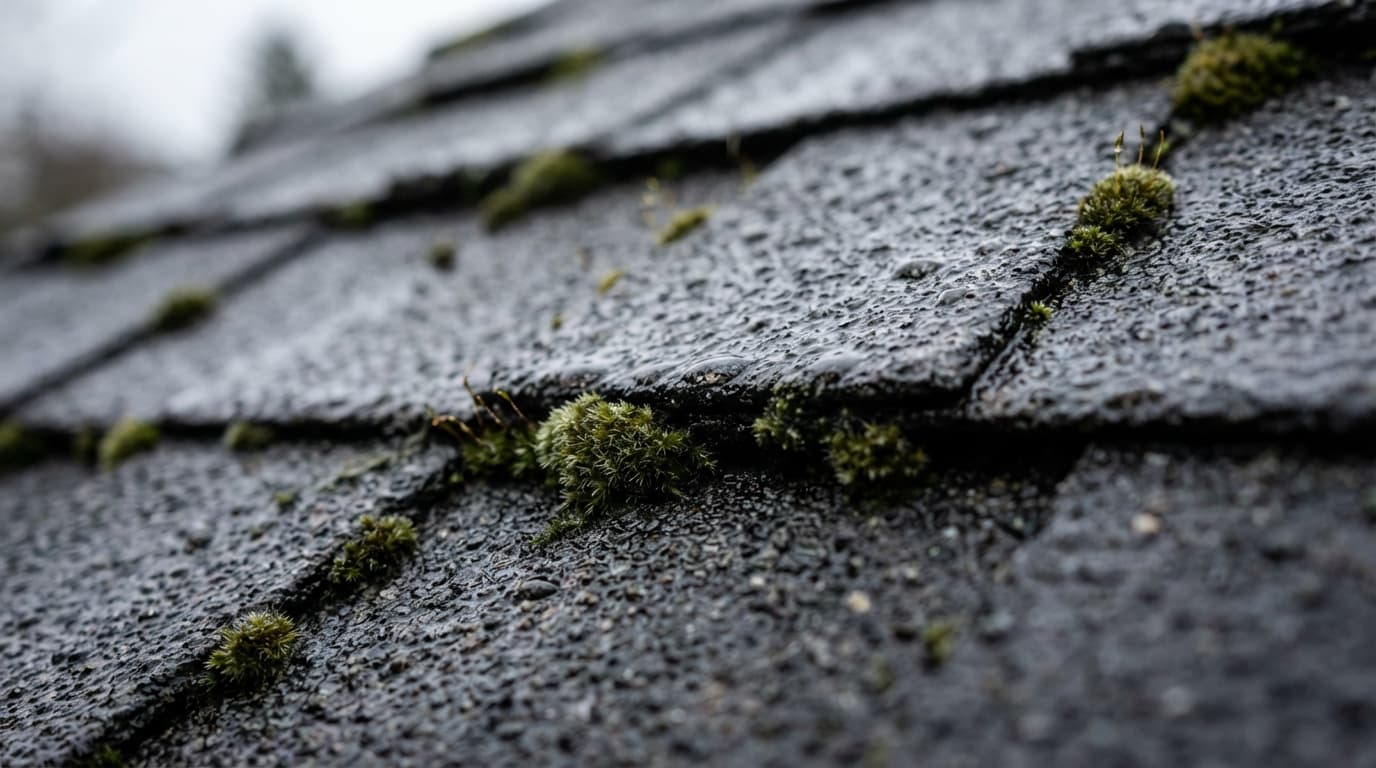
Does Insurance Cover Moss Damage on My Roof?
Standard homeowners insurance treats moss as maintenance neglect, so it does not pay. Here is what is covered, and how moss can sink a storm claim.
In Eugene, moss is the single most predictable thing that happens to a roof. The 50 inches of annual rain, the long shaded slopes under a Douglas fir canopy, and the mild winters give moss almost everything it needs, so on most older asphalt roofs in town it is a question of when, not if. That makes it tempting to assume that when moss finally lifts the shingles and water gets in, homeowners insurance will help pay to put things right.
It almost never does. Insurance is built to cover sudden, accidental events, and moss is the opposite of sudden. This guide explains why moss damage falls on the maintenance side of the line, what your policy actually does cover, and the more painful problem most Eugene homeowners miss: how an unmaintained, mossy roof can quietly undercut a legitimate storm claim.
Table of Contents
Does homeowners insurance cover moss damage?
No. Standard homeowners policies classify moss damage as a maintenance issue, not a covered peril, and they exclude it. Moss takes years to establish and to work its roots under shingle tabs, and insurance is designed to pay for sudden, accidental losses, not slow deterioration that good upkeep would have prevented. The two categories do not overlap, which is why even generous policies will not pay to remove moss or replace the shingles it has ruined.
The Insurance Information Institute puts it plainly: a standard policy will not pay for damage caused by routine wear and tear. Moss damage is the textbook example of the gradual, preventable wear that sits outside the policy.
Why do insurers treat moss as maintenance neglect?
Insurance is priced around risk pools and unpredictable events. Moss is neither unpredictable nor rare in a climate like Eugene's. If carriers paid for moss damage, nearly every homeowner with an aging asphalt roof would file, premiums would climb to cover it, and the whole pool would pay for what is fundamentally a homeowner upkeep cost. So policies are written assuming you keep the roof maintained, and they exclude the foreseeable items that maintenance handles.
Oregon State University Extension treats roof moss the same way: as a long-term maintenance problem homeowners are expected to manage before it does structural damage. When the people who study the climate and the people who price the risk agree that moss is a maintenance item, the exclusion is not an insurer technicality. It reflects how the damage actually happens.
What does homeowners insurance actually cover on a roof?
The dividing line is sudden versus gradual. A covered loss is a one-time event with a clear date: a windstorm tears shingles off, a falling limb punctures the deck, hail bruises the surface. Moss, rot, algae, and general age are gradual and excluded. The table below maps the difference for a typical Eugene roof.
| Roof damage | Typically covered? | Why |
|---|---|---|
| Wind-torn or blown-off shingles | Yes | Sudden storm event with a clear date |
| Tree limb puncturing the roof | Yes | Sudden, accidental impact |
| Hail bruising or fracturing shingles | Yes | Sudden weather event |
| Moss lifting and rotting shingles | No | Gradual; classed as maintenance neglect |
| Granule loss and general age | No | Normal wear and tear |
| Leak from long-deferred upkeep | No | Preventable deterioration |
The practical takeaway is that the cause of the damage matters more than the damage itself. The same hole in the deck can be covered or denied depending on whether the adjuster decides a storm made it or moss did.
How does moss complicate a storm damage claim?
This is where Eugene homeowners get caught. Say a windstorm genuinely strips shingles off your roof, a clearly covered event. The adjuster climbs up, and the slope is matted with moss and visibly deteriorated. Now the carrier has an opening to argue that the roof was already failing and that maintenance neglect, not the wind, caused or worsened the loss.
That argument can play out three ways: a reduced payout, a denial on the grounds the roof was already compromised, or coverage for a patch repair instead of the replacement the storm would otherwise have justified. The moss does not just go uncovered on its own; it weakens the claim for the damage that should have been covered.
A mossy roof is the easiest thing for an adjuster to point at when looking for a reason to reduce or deny a storm claim. Letting moss build up does not only cost you the repair; it can cost you a legitimate claim you would otherwise win.
How do I protect a future claim?
You cannot make insurance pay for moss, but you can keep moss from sabotaging the storm claims it is supposed to cover. The goal is a roof that an adjuster cannot credibly call neglected, plus a paper trail proving it.
- 1Keep moss treated before each wet season so the roof never reaches a visibly neglected state.
- 2Photograph the roof once a year in good condition, so you have dated evidence of upkeep if a claim is ever contested.
- 3Keep receipts for moss treatments, inspections, and any roof repairs as proof of maintenance.
- 4After a storm, document the fresh damage immediately and separately, before you do anything else, so its sudden cause is clear.
- 5If a claim is reduced over alleged neglect, your photos and receipts are the evidence that pushes back.
If a moss-affected slope does start leaking, a prompt targeted fix keeps a small problem from rotting the decking underneath and turning into the kind of deferred-maintenance damage no policy will touch.
Is it cheaper to prevent moss than to fix the damage?
Easily, and prevention is the only side of this where the money comes back, since insurance never will. A few low-cost specifications cut moss-driven cost over the life of a Eugene roof far more than any claim would.
- Zinc or copper ridge strips, roughly $150 to $400 installed, release trace metal with each rain that suppresses moss down the whole slope for 15 to 20 years.
- Algae-resistant architectural shingles with copper-treated granules slow moss colonization for the first 7 to 10 years.
- Regular professional moss treatment keeps shaded north-facing slopes from ever reaching the matted state an adjuster can use against you.
Together, these move the moss-treatment cycle from roughly every two years to every four or five, and add years of effective life to the roof underneath. That is a return insurance was never going to provide.
How do I check what my own policy says?
Do not rely on a general answer for your specific contract. Pull your declarations page, the summary that arrives with each annual renewal, and read the exclusions list. Moss, mildew, fungus, and gradual deterioration are usually named there outright. Non-standard carriers and endorsements can vary, so when the language is unclear, call your agent and ask directly.
Get any coverage answer in writing. A short email from your agent confirming what is and is not covered is worth keeping, so there is no dispute about what you were told if you ever need to file.
Frequently Asked Questions
Does homeowners insurance cover moss damage on my roof?
No. Standard homeowners policies classify moss as a maintenance issue rather than a covered peril and exclude it. Moss damage develops slowly over years, and insurance is designed for sudden, accidental losses, so neither moss removal nor moss-damaged shingles are paid for.
Why won't insurance pay for moss damage?
Because moss damage is gradual and preventable, not sudden and accidental. Insurers price policies assuming homeowners maintain the roof, and they exclude foreseeable wear like moss, rot, and general age. In a wet climate like Eugene's, moss is treated as a near-universal upkeep responsibility.
What roof damage does homeowners insurance actually cover?
Sudden, dated events: shingles torn off by a windstorm, a tree limb puncturing the deck, hail damage. Gradual problems like moss, algae, rot, and granule loss from age are excluded as wear and tear or maintenance neglect.
Can moss cause my storm damage claim to be denied?
Yes. If an adjuster inspects after a storm and finds a mossy, deteriorated roof, the carrier can argue maintenance neglect caused or worsened the loss, leading to a reduced payout, a denial, or coverage for only a partial repair instead of replacement.
How do I keep moss from hurting a future insurance claim?
Keep moss treated before each wet season, photograph the roof in good condition once a year, and keep receipts for treatments and repairs. Document fresh storm damage separately and immediately so its sudden cause is clear and an adjuster cannot blame pre-existing moss.
Where can I find out exactly what my policy excludes?
Read the exclusions list on your declarations page, the summary that comes with each renewal. Moss, mildew, fungus, and gradual deterioration are usually listed there. If the wording is unclear, ask your agent directly and get the answer in writing.